Last updated: June 2026 · By iCreatixPRO
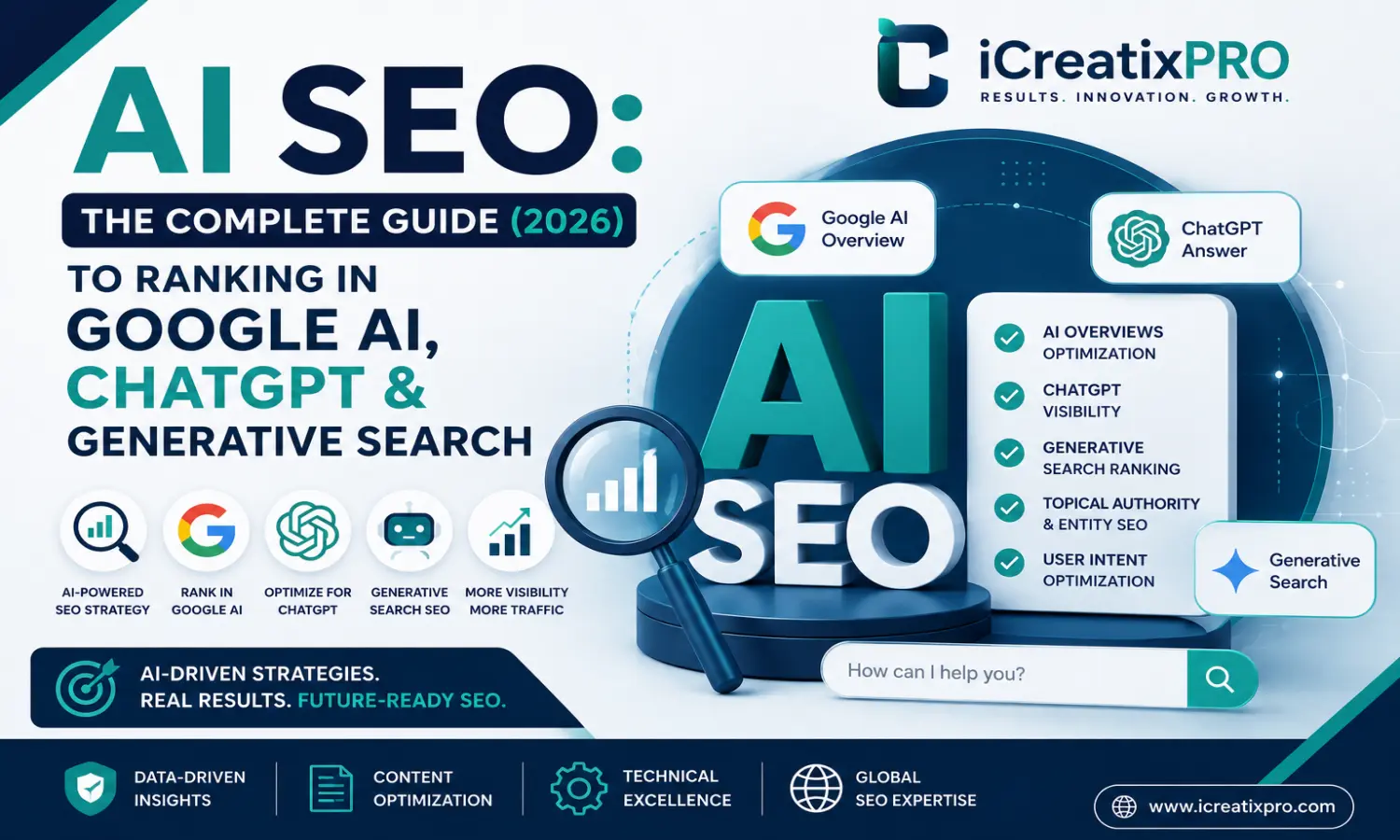
If you've noticed your traffic shifting, your rankings wobbling, or answers showing up above the search results before anyone clicks anything, you're not imagining it. Search has changed. AI SEO is no longer a "nice to have" experiment for early adopters; it's how content gets found in Google's AI Overviews, ChatGPT, Perplexity, and Gemini in 2026.
This guide breaks down what AI SEO actually is, why it's different from the SEO you learned five years ago, and a practical AI SEO strategy you can start using today.
What Is AI SEO?
AI SEO is the practice of optimizing your content so it gets discovered, understood, cited, and recommended by AI-powered search and answer engines, not just traditional ranked links.
In plain terms: classic SEO tried to win the #1 blue link. AI SEO tries to become the source the AI quotes when it writes the answer. Those are related goals, but they're not identical, and the difference is where most sites are losing ground.
This newer discipline overlaps with a few terms you'll see thrown around:
- GEO (Generative Engine Optimization)
- AEO (Answer Engine Optimization)
- LLM SEO or "optimizing for ChatGPT"
They all point at the same shift: machines now read, summarize, and re-present your content before a human ever sees it.
Quick definition: AI SEO = making your content the most quotable, trustworthy, and machine-readable answer to a question your audience is asking.
Why AI SEO Matters Now (And Why Old Tactics Are Fading)
A few things changed at once:
- Zero-click answers exploded. Google's AI Overviews summarize the answer at the top of the page. Users get what they need without clicking, unless your brand is the one being cited.
- People ask AI directly. A growing share of "searches" now happen inside ChatGPT, Gemini, and Perplexity. If you're not in those answers, you're invisible to that audience.
- Keyword stuffing is dead, intent is everything. AI models understand meaning, not just matching strings. Writing for topics and intent beats writing for exact-match phrases.
The takeaway: visibility is no longer just "rank #1." It's "be the trusted source the AI repeats."
How AI Search Engines Actually Pick Sources
You can't optimize for something you don't understand, so here's the simplified version of how generative engines decide who to cite:
- Relevance to intent - does your content directly answer the specific question?
- Clarity and structure - can the model easily extract a clean, self-contained answer?
- Authority and trust - does your site demonstrate real expertise (the E-E-A-T idea: Experience, Expertise, Authoritativeness, Trust)?
- Corroboration - do other credible sources agree with you? AI engines love consensus.
- Freshness - is the information current? Stale content gets skipped on fast-moving topics.
Notice that most of these aren't "tricks." They reward genuinely good, well-organized content. That's the whole game in 2026.
A Practical AI SEO Strategy (Step by Step)
Here's a repeatable AI SEO strategy you can apply to any page.
1. Build Topical Authority, Not Just Single Posts
AI engines trust sources, not lone articles. The way you signal authority is by covering a topic thoroughly across a cluster of connected content.
- Pick a core topic (your "pillar," e.g. this AI SEO guide).
- Write supporting articles for sub-questions (e.g. "What is GEO?", "AI SEO tools compared", "How to optimize for ChatGPT").
- Internally link them together so both readers and crawlers see the relationship. (Link this pillar to your sub-posts at /blog/geo-explained, /blog/ai-seo-tools, and /blog/optimize-for-chatgpt.)
Topical authority is the single biggest lever for AI visibility. One great post rarely wins; a connected, comprehensive cluster does.
2. Write Answer-First Content
Lead with the answer, then explain. AI engines extract concise, self-contained statements, so give them one.
- Put a direct 1-2 sentence answer right under each heading.
- Use questions as headings (they match how people prompt AI).
- Add a TL;DR or key takeaways box near the top.
3. Structure for Extraction
Make your content easy for a machine to lift cleanly:
- Short paragraphs (2-4 sentences).
- Descriptive H2/H3 headings that map to real questions.
- Bulleted lists, numbered steps, and comparison tables.
- A clear definition for any key term, near its first mention.
4. Target Intent and Keywords Together
Keywords still matter, you just use them naturally. Weave in your primary and secondary terms where they fit:
- Primary keywords: AI SEO, AI SEO guide
- Secondary keywords: AI SEO services, AI SEO strategy, plus related phrases like GEO, AEO, AI Overviews, optimizing for ChatGPT.
Use them in your title, an H2 or two, the intro, and naturally throughout, never forced. Modern engines penalize stuffing and reward readable, on-topic writing.
5. Add Schema and Technical Signals
Help machines parse your page:
- Article, FAQPage, and HowTo structured data where relevant.
- Fast load times and clean mobile rendering.
- Descriptive title tags and meta descriptions that state the answer.
6. Earn Trust Signals (E-E-A-T)
- Show a real author with credentials.
- Cite credible sources and link out where appropriate.
- Keep content updated with a visible "last updated" date.
- Collect mentions and links from other reputable sites.
7. Measure What AI Sees
Track beyond classic rankings:
- Monitor impressions/clicks in Search Console for AI-influenced queries.
- Prompt the engines yourself, ask ChatGPT, Gemini, and Perplexity your target questions and see who they cite.
- Watch referral traffic from AI tools as those sources grow.
AI SEO Services: DIY or Hire Help?
If this feels like a lot, that's because it spans content, technical setup, and ongoing measurement. Many teams bring in AI SEO services to move faster, especially for schema, content clusters, and tracking. If that's you, point readers to your offer here: Learn how iCreatixPRO's AI SEO services work.
Doing it in-house is completely viable too; just commit to the topical-cluster approach and consistent updates.
Common AI SEO Mistakes to Avoid
- Chasing exact-match keywords instead of answering intent.
- Thin, one-off posts with no supporting cluster.
- Burying the answer under 600 words of preamble.
- No structured data, leaving machines to guess.
- Letting content go stale on fast-moving topics.
- Faking expertise, AI engines increasingly detect and skip low-trust content.
Key Takeaways
- AI SEO means becoming the source AI engines cite, not just the link that ranks.
- Topical authority + internal linking is your strongest lever.
- Write answer-first, well-structured content that machines can extract.
- Use keywords naturally; optimize for intent, add schema, and prove E-E-A-T.
- Measure by asking the AI engines directly who they recommend.
FAQ
What is AI SEO?
AI SEO is optimizing content so AI-powered search and answer engines (like Google AI Overviews, ChatGPT, and Perplexity) understand, trust, and cite it as a source.
Is AI SEO different from traditional SEO?
They share fundamentals, but AI SEO focuses on being the quoted answer in generative results, not only ranking a blue link. Structure, intent, and trust matter even more.
Can I guarantee a #1 ranking or AI Overview placement?
No, and be wary of anyone who promises it. You can strongly improve your odds with the strategy above, but rankings depend on factors outside any single site's control.
How long does AI SEO take to work?
Typically weeks to a few months, faster if you already have authority on the topic, slower for new sites building trust from scratch.
Ready to Put AI SEO Into Practice?
Start with one pillar page, build a cluster around it, and measure by asking the AI engines directly. Need a hand? Talk to the iCreatixPRO team or explore our AI SEO services.
