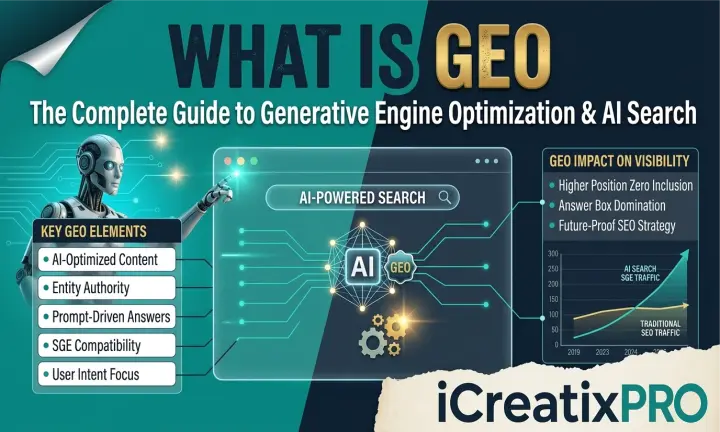
TL;DR
Generative Engine Optimization (GEO) is the practice of optimizing your content, brand, and digital presence so that AI-powered search engines such as ChatGPT, Google AI Overviews, Gemini, and Perplexity retrieve, cite, and recommend your business in their generated responses.
Unlike traditional SEO, which focuses on ranking in a list of blue links, GEO focuses on becoming the trusted answer inside conversational AI summaries. In 2026, AI assistants influence millions of buying decisions before a single website is visited. If your brand is invisible inside those answers, you are invisible to a growing segment of your market.
Step 01: Most businesses have never heard of GEO which means adopting it now puts you ahead of the curve before competitors catch up.
Step 02: If you're already running SEO campaigns, GEO is the logical next layer one that protects your organic visibility as AI search behavior accelerates.
Step 03: Ready to find out whether AI systems currently recommend your brand? Book a GEO visibility audit with iCreatixPRO and discover exactly where your business stands inside AI-generated answers.
Insights by iCreatixPRO AI search strategy, semantic SEO, and GEO implementation for forward-thinking brands.
What Is GEO and Why AI Search Is Redefining Digital Visibility
What Is Generative Engine Optimization (GEO), Really?
Generative Engine Optimization (GEO) is the discipline of making your brand, content, and entity data optimized for retrieval and citation by large language models (LLMs) and AI-powered search systems.
Where traditional SEO asks: "How do I rank on Google page one?", GEO asks a fundamentally different question: "How does an AI assistant decide to mention my brand when a user asks a relevant question?"
The shift matters because:
- AI systems like ChatGPT, Google Gemini, and Perplexity generate direct answers not lists of links
- Users increasingly trust and act on AI-generated summaries without clicking through to a website
- Your brand can influence purchasing decisions, research journeys, and brand discovery entirely through AI citations
- Visibility inside AI answers is now as commercially valuable as a first-page Google ranking
Think of GEO as earning a seat at the table where AI assistants discuss your industry. If your content, authority, and entity signals are strong, AI systems reference you. If they aren't, a competitor gets mentioned instead.
How GEO Differs From Traditional SEO Without Replacing It
GEO does not replace SEO it extends it into a new dimension of visibility.
| Dimension | Traditional SEO | Generative Engine Optimization (GEO) |
|---|---|---|
| Primary Goal | Rank in search results | Be cited in AI-generated answers |
| Optimization Target | Google algorithm signals | LLM retrieval and trust signals |
| Key Currency | Backlinks + rankings | Entity authority + semantic depth |
| Output Metric | Organic clicks | AI citation frequency + brand mentions |
| Core Method | Keyword targeting | Entity-first + conversational formatting |
| Visibility Type | SERP position | AI summary inclusion |
| User Behavior | Click to website | Receive answer directly from AI |
| Tools Used | Search Console, Ahrefs | Prompt testing, AI visibility trackers |
Both disciplines share a common foundation: authoritative, well-structured, technically sound content. The difference is where that content needs to perform.
SEO gets you ranked. GEO gets you recommended.
In practice: A brand that publishes a well-structured expert guide on commercial insurance might rank #3 on Google and simultaneously be cited by ChatGPT when users ask "what should I know before buying commercial insurance?" GEO and SEO reinforce each other when implemented strategically.
The Evolution From SEO to GEO in the Age of AI Search
Why Search Behavior Changed Faster Than Most Brands Expected
Search was already changing before generative AI arrived. Voice search, featured snippets, and zero-click SERPs were early signals that users wanted answers not just links. Generative AI accelerated that shift dramatically.
Key behavioral shifts reshaping digital visibility:
- Conversational queries now dominate: users ask full questions, not fragmented keyword strings
- AI summaries reduce the need to visit multiple websites one synthesized answer replaces ten blue links
- Trust in AI-generated responses is increasing, especially among professional, educated, and B2B audiences
- Zero-click behavior is normalizing users get what they need from the AI overview itself
The psychology is simple: friction reduction. AI assistants deliver synthesized, confident answers instantly. Users who experience this level of convenience rarely go back to scanning ten results manually.
For brands, this creates an urgent question: Are we visible where our audience is now discovering information?
Search Engines vs Answer Engines Explained Simply
A search engine retrieves a ranked list of web pages relevant to a query. A user still decides which result to click.
An answer engine processes the query, synthesizes information from multiple trusted sources, and delivers a single confident response often with citations.
ChatGPT, Google AI Overviews, Perplexity, and Bing Copilot are answer engines. They do not simply retrieve they generate a curated response.
In this model:
- Citations are the new rankings. If an AI cites your content, your brand earns visibility.
- Traffic is secondary to trust. You may influence a buying decision without receiving a single website visit.
- Authority now operates at the entity level, not just the page or domain level.
MOFU Note: If your competitors are being cited in AI answers and you aren't, they're winning discovery conversations you never even knew were happening. Explore iCreatixPRO's GEO optimization services to close that visibility gap.
GEO vs SEO What Actually Changed in 2026?
The Real Difference Between SEO, AI SEO, and GEO
Three overlapping disciplines now define modern search visibility:
Traditional SEO focuses on improving a website's rankings within standard search engine results pages. It targets Google's algorithmic signals: technical performance, content quality, backlink authority, and user experience.
AI SEO refers to using AI tools to assist, accelerate, or enhance traditional SEO workflows content ideation, keyword clustering, competitive analysis, and content optimization at scale.
Generative Engine Optimization (GEO) is a distinct discipline focused on making a brand or entity visible, trustworthy, and citable within AI-generated responses. GEO targets AI retrieval systems, not just Google's ranking algorithm.
Modern brands need all three working together:
- SEO builds the technical and authority foundation
- AI SEO improves production efficiency and scale
- GEO ensures visibility inside the growing AI answer ecosystem
Why Entity Authority Now Matters More Than Topical Authority
In traditional SEO, topical authority meant publishing comprehensive content clusters around a subject. In the GEO era, entity authority is becoming equally critical.
An entity is a clearly defined, recognizable thing a brand, a person, a concept, a product. Google's Knowledge Graph and AI language models understand the world through entities and the relationships between them.
To earn AI visibility, your brand entity needs to be:
- Consistently named and described across your website, social profiles, PR mentions, and third-party sources
- Associated with trusted topics through co-citation being mentioned alongside recognized authorities in your field
- Disambiguated clearly AI systems must be able to distinguish your brand from similarly named entities
In practice: A financial advisory firm called "Clarity Wealth" should have consistent entity descriptions across LinkedIn, Google Business Profile, authoritative financial directories, and earned media coverage. This cross-platform consistency helps AI models recognize and trust the entity and include it in relevant generated answers.
How Generative Engine Optimization Actually Works Behind the Scenes
Retrieval-Augmented Generation (RAG) and AI Content Retrieval
Most modern AI search systems including those powering Google AI Overviews and Perplexity use a method called Retrieval-Augmented Generation (RAG).
Here's how it works in simplified terms:
- A user submits a query to an AI assistant
- The AI system retrieves relevant documents, pages, or data from an indexed knowledge base
- The LLM synthesizes retrieved information to generate a coherent, accurate response
- The response may include citations pointing back to the source content
What this means for optimization:
- Content that is clearly structured, factually accurate, and semantically rich is more likely to be retrieved
- Concise, direct answers embedded within larger content increase citation likelihood
- Semantic chunking organizing content into clearly defined concept blocks helps AI systems extract relevant passages
- Authoritative sources are consistently prioritized over thin, generic content
Think of RAG as a highly intelligent research assistant. You want your content to be the source this assistant reaches for first.
How AI Crawlers and AI Agents Understand Websites
AI crawlers differ from traditional search bots in important ways. Where Google's crawler indexes pages for ranking, AI crawlers and agents parse content to understand meaning, context, and trustworthiness.
Key technical factors that influence AI discoverability:
- Crawl accessibility: AI systems cannot retrieve content behind paywalls, broken JavaScript rendering, or robots.txt exclusions
- Schema markup: Structured data signals provide machine-readable context about your content type, author, organization, and topic
- Semantic HTML structure: Clean heading hierarchies help AI systems identify content sections and extract specific answers
- Internal linking: Coherent link architecture helps AI understand relationships between concepts across your content ecosystem
- Content freshness: Outdated factual information reduces citation likelihood, as AI systems prefer current and accurate sources
In practice: A website with clearly marked FAQ sections, Article schema, and well-structured H2/H3 hierarchies gives AI extractors cleaner signals than a page built entirely in JavaScript with no structured data.
Engagement CTA: Want to know whether your website is currently visible inside AI-generated search results? A GEO visibility audit can reveal exactly how platforms like ChatGPT, Gemini, and Google AI Overviews interpret your brand today. Request your audit from iCreatixPRO.
The Core GEO Strategies Smart Brands Are Using Right Now
Writing GEO-Optimized Content That AI Systems Prefer
Content optimized for generative engines shares several consistent characteristics:
1. Direct-answer formatting. Every major section should open with a clear, concise answer to the implied question. AI systems prioritize content that answers first and elaborates second.
2. Semantic completeness. Cover a topic thoroughly enough that an AI system can extract a complete, coherent answer from your content alone without needing to synthesize from multiple inferior sources.
3. Conversational readability. Write for how users speak their queries, not just how they type keywords. AI assistants respond to conversational queries; your content should match that register naturally.
4. Citation-friendly structure. Use clearly delineated sections, subheadings, and pull-out facts that AI extractors can isolate and attribute. Statistics, frameworks, and original research are especially citation-worthy.
5. Factual precision. AI systems are calibrated to prioritize accuracy. Content containing verifiable data, correctly attributed claims, and current information consistently outperforms vague generalities.
Entity-First SEO and Semantic Optimization Strategies
Entity-first optimization shifts the focus from individual keywords to the concepts and relationships your content represents within an AI knowledge system.
Practical implementation steps:
- Map your core entity: Define your brand, its category, its key products, and its domain of expertise clearly across all content
- Build semantic topic clusters: Create interconnected content that covers a subject comprehensively from multiple angles, helping AI systems recognize your depth of expertise
- Align with Knowledge Graph categories: Use schema markup and structured descriptions that match how Google's Knowledge Graph classifies entities in your industry
- Cross-platform consistency: Ensure your entity description is consistent across your website, Google Business Profile, Wikipedia (if applicable), industry directories, LinkedIn, and earned media mentions
- Earn co-citations: Appear in the same authoritative content as recognized experts, trusted publications, and industry leaders in your space
Semantic depth beats keyword repetition every time in the GEO era. An AI model reading your content should be able to identify your expertise, your trustworthiness, and your unique contribution to the subject not just that you used a keyword fifteen times.
Why GEO Matters for Businesses, Brands, and B2B Companies
AI Search Is Already Influencing Buyer Decisions
Across B2B and B2C markets, AI assistants are actively shaping how buyers research, evaluate, and choose vendors, products, and services often before they ever reach a company's website.
Consider the buyer journey in 2026:
- A procurement manager asks ChatGPT: "What are the best project management platforms for mid-size construction companies?"
- ChatGPT generates a summary mentioning three vendors by name all with strong entity authority and GEO-optimized content
- The procurement manager shortlists those three vendors and begins vendor outreach
- Vendors not mentioned in the AI response are never considered
This is not a hypothetical. It is happening across industries at scale. The brands earning AI mentions are those that have intentionally or inadvertently built the entity authority and content depth that AI systems trust.
The ROI formula is straightforward:
GEO ROI = (AI-Influenced Revenue − GEO Investment) ÷ GEO Investment × 100
Early adopters report significant increases in inbound inquiry quality because AI-cited brands arrive pre-vetted in the minds of their prospects.
Why Early GEO Adoption Creates Competitive Advantage
GEO authority compounds over time in a way that makes early adoption disproportionately valuable.
- AI systems build trust in entities through consistent, repeated recognition across sources
- Brands cited early in AI answers tend to stay cited authority signals reinforce themselves
- Competitors who wait to adopt GEO must overcome an established authority gap
- The window for first-mover advantage in GEO is measurably narrowing
In practice: A cybersecurity consulting firm that invests in GEO in mid-2026 has a realistic opportunity to be the recommended vendor when enterprise buyers ask AI assistants about cybersecurity strategy. A competitor who waits until 2027 faces an entrenched authority ecosystem.
The Rise of Zero-Click Search and AI-Generated Answers
How Google AI Overviews and Generative Search Are Changing Traffic
Google's AI Overviews (formerly Search Generative Experience / SGE) represent the most commercially significant transformation of Google Search since the introduction of featured snippets.
When AI Overviews appear:
- A synthesized AI-generated answer displays above organic results
- Users frequently receive a complete answer without scrolling to organic listings
- Zero-click behavior increases users trust the AI summary and exit the search
- Organic click-through rates for queries with AI Overviews are measurably lower for many result types
For brands, this creates a dual imperative:
- Optimize for AI Overview inclusion be one of the sources cited inside the generated answer
- Maintain strong traditional SEO organic rankings still matter for queries where AI Overviews don't appear or where users seek deeper exploration
The brands that win in zero-click environments are not those who lament lost traffic they are those who have positioned themselves as the answer, so that even when a user never clicks through, they leave the search experience knowing and trusting that brand.
Owning the answer is more valuable than owning the ranking in an AI-first search landscape.
Practical GEO Implementation for Modern Websites
A Beginner-Friendly GEO Framework for 2026
If you're new to generative engine optimization, this four-stage framework provides a practical starting point:
Stage 1 Entity & Query Research
- Define your brand entity clearly with consistent descriptions
- Identify the conversational questions your audience asks AI assistants
- Map those questions against your existing content to find gaps
Stage 2 Content Structure for AI Readability
- Reformat key pages with direct-answer openings
- Add clear semantic headings aligned with conversational queries
- Implement FAQ sections optimized for extraction
- Ensure schema markup (Article, FAQ, Organization) is implemented correctly
Stage 3 Authority & Trust Signal Development
- Pursue earned media and PR mentions that reinforce your entity
- Build co-citation relationships through thought leadership and guest contribution
- Maintain factual accuracy and keep content freshness updated
- Strengthen cross-platform entity consistency
Stage 4 Monitoring & Iteration
- Test AI visibility by manually querying ChatGPT, Gemini, and Perplexity with target questions
- Track brand mention frequency and sentiment in AI-generated responses
- Monitor AI Overview appearances using Google Search Console data
- Adjust content and authority strategies based on observed citation patterns
Technical SEO Foundations Still Essential for GEO
GEO does not make technical SEO obsolete it depends on it. If AI crawlers cannot access and understand your content, no amount of entity authority will make you visible inside AI answers.
Non-negotiable technical foundations for GEO success:
- Crawlability: Ensure your content is accessible to AI crawlers and not inadvertently blocked
- Core Web Vitals: Page speed and stability affect both Google rankings and AI retrieval accessibility
- Structured data: Implement Article, FAQ, Organization, Breadcrumb, and Speakable schema markup
- Clean HTML architecture: Logical heading hierarchies improve AI extraction accuracy
- Internal linking: Help AI systems understand conceptual relationships across your content
Explore the full technical SEO and GEO toolset at iCreatixPRO Tools to audit your current AI readiness.
Measuring GEO Performance and AI Search Visibility
The New GEO Metrics That Matter in 2026
Traditional SEO KPIs rankings, organic traffic, click-through rate remain important but are no longer sufficient to capture the full picture of search visibility.
GEO introduces a new set of performance metrics:
| GEO Metric | What It Measures | Why It Matters |
|---|---|---|
| AI Citation Frequency | How often your brand is mentioned in AI-generated responses | Indicates AI trust and entity authority level |
| Entity Mention Visibility | Cross-platform consistency of brand entity references | Signals disambiguation and AI recognition strength |
| AI Overview Appearance Rate | Frequency of inclusion in Google AI Overview summaries | Directly affects zero-click brand exposure |
| AI Brand Sentiment | Tone and context of AI-generated mentions | Indicates whether AI systems represent you accurately |
| Prompt-Level Ranking | Your brand's position in AI-generated answer lists | Measures competitive standing in AI recommendations |
| Citation Source Diversity | Number of distinct platforms where AI retrieves your content | Reflects breadth of entity authority |
How to Monitor AI Search Mentions and Performance
Monitoring GEO performance requires different methods than traditional rank tracking:
- Prompt-level testing: Manually query ChatGPT, Gemini, Claude, and Perplexity with your target buyer questions regularly note when your brand appears, in what context, and at what position
- Query fan-out testing: Test variations of your core queries to understand the breadth of scenarios where your brand earns AI visibility
- Competitive analysis: Run the same AI queries you'd want to appear in and note which competitors are currently being cited instead
- Google Search Console: Monitor AI Overview appearance rates and click data for queries where you appear in AI summaries
- Brand monitoring tools: Use tools like Mention or Brand24 to capture broader web mentions that contribute to AI co-citation signals
Traditional ranking tools built for Google SERPs cannot capture AI visibility. GEO measurement requires a combination of manual prompt testing and emerging AI search monitoring platforms.
Risks, Challenges, and Misconceptions Around GEO
Is SEO Dead or Simply Evolving Into Something Bigger?
SEO is not dead. This claim resurfaces with every major search evolution the rise of social media, the mobile shift, voice search, featured snippets and it has never proven accurate.
What is true: SEO is expanding its scope.
AI search systems are built on top of the web content that traditional SEO has indexed, structured, and ranked for decades. Without robust technical SEO foundations, AI systems cannot access or trust the content they need to generate accurate responses.
SEO and GEO coexist because:
- AI systems use indexed web content as their primary knowledge source
- Technical optimization enables AI crawlers to retrieve your content
- Backlink authority still signals trustworthiness to AI models
- Organic rankings remain the primary traffic driver for most query types
The brands who will struggle are those who abandon SEO in favor of GEO exclusively or who ignore GEO entirely while competitors build AI visibility advantages.
The Real Risks of AI SEO and Generative Optimization
GEO adoption carries genuine risks that brands should address proactively:
AI misinformation risk: AI systems occasionally generate inaccurate summaries even from authoritative sources. Monitor AI-generated mentions of your brand to identify and address factual errors before they influence buyer perception.
Over-reliance risk: AI search traffic patterns are less predictable than organic search. Brands that build their entire acquisition model on AI visibility face concentration risk if AI systems change retrieval behavior.
Content quality risk: The proliferation of AI-generated content in pursuit of GEO visibility risks flooding the web with low-quality material that harms rather than helps your entity authority. AI systems increasingly distinguish between original expert insight and recycled AI output.
Human expertise remains irreplaceable. The brands earning the strongest AI citations in 2026 are those publishing original research, genuine expert perspectives, and first-hand industry analysis content that AI systems cannot generate themselves.
The Future of GEO, AI SEO, and Search Visibility Beyond 2030
What the Future of SEO and AI Discovery Will Likely Look Like
Several emerging trends will shape how brands optimize for discovery in the next five years:
Conversational interfaces as default: Increasingly, users will interact with AI assistants as their primary search interface bypassing traditional search engine results pages altogether for many query types.
Multimodal AI search: Future AI systems will retrieve and synthesize information across text, images, video, and audio simultaneously. Brands with rich, multimodal content ecosystems will earn broader visibility.
Personalized AI discovery: AI assistants will increasingly tailor answers to individual user context past behavior, stated preferences, and geographic relevance. Hyper-local entity optimization will become more strategically important.
Autonomous AI research agents: AI systems will increasingly perform multi-step research tasks autonomously visiting websites, reading reports, comparing vendors without human direction at each step. The brands best positioned for agent-driven discovery will be those with the most coherent, trustworthy content ecosystems.
A New Mindset for Marketers in the AI Search Era
The strategic shift GEO demands is not primarily tactical it is philosophical.
| Old Mindset | New Mindset |
|---|---|
| Chase rankings | Build recognition |
| Drive traffic | Earn trust |
| Target keywords | Define entities |
| Publish content | Build authority ecosystems |
| Optimize for algorithms | Optimize for humans and machines |
| Measure clicks | Measure visibility and influence |
Helpfulness is the strongest ranking signal in the AI era not because helpfulness was invented by AI search, but because AI systems are remarkably good at recognizing genuine usefulness and dismissing performative content optimized purely for algorithmic signals.
The brands that will dominate AI-powered discovery are those that commit to becoming genuinely authoritative, genuinely helpful, and genuinely trustworthy in their domain across every platform, format, and interaction touchpoint.
Frequently Asked Questions About GEO and AI Search Optimization
What is generative engine optimization?
Generative Engine Optimization (GEO) is the practice of optimizing your brand, content, and entity presence so that AI-powered search platforms including ChatGPT, Google AI Overviews, Gemini, and Perplexity retrieve, cite, and recommend your business within their generated responses.
Is GEO replacing traditional SEO?
No. GEO extends SEO rather than replacing it. Traditional SEO remains essential for organic search rankings, which AI systems still rely on to identify authoritative content. GEO adds a new optimization layer targeting AI retrieval and citation systems specifically.
What is the difference between SEO and GEO?
SEO focuses on ranking in traditional search engine results pages. GEO focuses on being cited or recommended inside AI-generated answers. SEO targets algorithmic ranking signals; GEO targets AI trust signals, entity authority, and semantic content structure.
How do AI search engines decide what to recommend?
AI search systems use Retrieval-Augmented Generation (RAG) to pull relevant content from indexed sources before generating a response. They prioritize content that is authoritative, factually accurate, clearly structured, and semantically comprehensive then synthesize that content into a generated answer with citations.
What content is most likely to be cited by ChatGPT or Gemini?
AI systems consistently prefer original research, expert-led analysis, well-structured educational content, and high-trust authoritative sources. Content formatted with direct answers, clear semantic structure, and accurate factual information earns citations most reliably.
What is entity-first SEO and why does it matter for GEO?
Entity-first SEO focuses on optimizing around clearly defined concepts and entities rather than isolated keywords. For GEO, entity clarity is critical: AI systems need to recognize your brand as a distinct, trusted entity before they will consistently include you in relevant generated responses.
How can businesses optimize for AI Overviews in Google?
To improve Google AI Overview inclusion: implement Article and FAQ schema markup, structure content with direct-answer openings, use clear semantic headings, publish factually accurate and current information, and build E-E-A-T signals through expert authorship, earned media, and authority backlinks.
What technical SEO elements affect GEO performance?
Crawlability, structured data implementation (especially Article, FAQ, Organization, and Speakable schema), clean HTML heading architecture, Core Web Vitals performance, and coherent internal linking all directly affect whether AI systems can access, understand, and trust your content for retrieval purposes.
How do I measure GEO performance?
GEO performance is measured through AI citation frequency (manually testing queries across ChatGPT, Gemini, Perplexity), AI Overview appearance rates (via Google Search Console), brand mention monitoring, entity recognition consistency audits, and competitive AI answer analysis.
What are the risks of focusing only on GEO without traditional SEO?
Over-indexing on GEO at the expense of SEO creates significant risk. AI systems retrieve content from the indexed web meaning strong traditional SEO is a prerequisite for GEO visibility. Brands that neglect technical SEO, content quality, and backlink authority will find their GEO performance limited by a weak underlying foundation.
Key Takeaways How Smart Brands Should Approach GEO in 2026
- GEO expands SEO it does not replace it. Strong technical and content SEO remains the foundation that GEO builds upon.
- AI visibility is a core marketing asset in 2026. AI-generated answers influence buyer decisions at the discovery stage, often before a website is ever visited.
- Entity authority matters more than ever. Consistent, cross-platform entity signals are critical for AI recognition and citation.
- Helpful, trustworthy, expert content wins across all AI systems. Generic, thin, or AI-recycled content consistently loses to original human insight.
- Early GEO adopters compound their advantage over time. Authority ecosystems built now will be significantly harder for late-moving competitors to displace.
- Brands must optimize for both humans and machines simultaneously. The brands winning in AI search are those who never sacrificed genuine usefulness for algorithmic cleverness.
Final CTA: If your business depends on organic visibility, now is the time to prepare for AI-powered discovery. Investing in GEO today strengthens your rankings, AI citation frequency, brand authority, and long-term search resilience across Google, ChatGPT, Gemini, and every AI platform still emerging. Explore iCreatixPRO's full GEO and AI SEO services or contact our team to build your GEO strategy today.
Published by iCreatixPRO Helping brands build authority, visibility, and trust in the AI search era.
