TL;DR
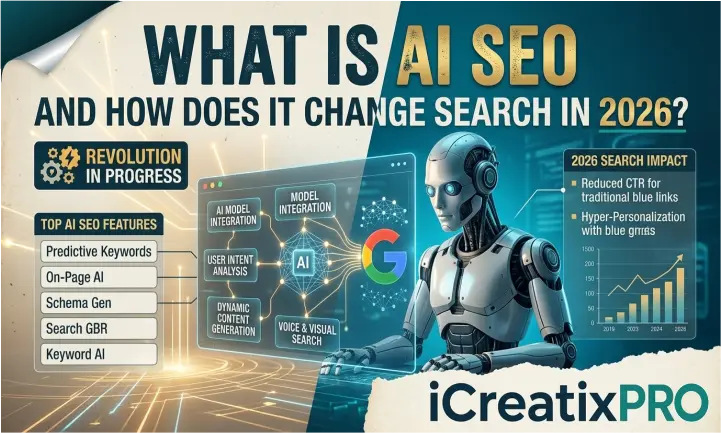
AI SEO is the practice of optimizing your content, brand, and technical infrastructure so that AI-powered search engines including Google AI Overviews, ChatGPT, Gemini, and Perplexity discover, understand, cite, and recommend your business.
In 2026, showing up on page one is no longer enough. Your brand must be the answer inside AI-generated responses. Companies that adapt to this shift early are capturing zero-click visibility, AI citations, and compounding authority signals that traditional SEO cannot replicate.
Whether you are just entering the AI search landscape (01), evaluating how your current strategy performs (02), or ready to take action with a structured AI visibility system (03) this guide covers every layer.
Ready to see where your brand stands in AI search? Request a Free AI Visibility Audit →
Insights by iCreatixPRO Senior SEO Strategists & AI Search Specialists
Why AI SEO Has Become the Center of Modern Search Strategy
Search has fundamentally changed. For decades, SEO meant optimizing pages so humans clicked blue links. Today, AI systems read your content, synthesize it, and deliver a direct answer often without a single click to your website.
This is the defining shift of 2026: discoverability has moved from rankings to citations.
What AI SEO Actually Means in the Age of Generative Search
AI SEO refers to the dual practice of using artificial intelligence tools to improve search optimization workflows, while simultaneously optimizing content and technical structure to be understood, trusted, and cited by AI-powered search systems.
There are two distinct dimensions:
- "AI for SEO" using machine learning, NLP tools, and AI assistants to research, create, and optimize content faster and smarter.
- "SEO for AI" structuring your content, entities, and authority signals so AI search engines like Google AI Overviews, Perplexity, and ChatGPT surface your brand in their generated answers.
Traditional SEO optimized for keyword rankings. AI SEO optimizes for contextual authority, entity recognition, and citation inclusion inside AI-generated responses.
Why does this distinction matter? Because ranking on page one no longer guarantees visibility. When a user asks ChatGPT or Gemini a question, those systems pull from sources they consider authoritative, semantically complete, and structurally clear not necessarily from whoever ranks number one on Google.
The brands winning AI search are not the ones with the most backlinks. They are the ones AI systems trust most.
How AI Search Engines Understand Intent, Entities & Context
AI search engines do not match keywords. They interpret meaning, entity relationships, and conversational intent using large language models (LLMs) trained on vast corpora of text.
When a user types a query, an LLM performs what researchers call query fan-out expanding the question into multiple semantic sub-intents, identifying the entities involved, and retrieving content that best satisfies the full intent landscape.
This means:
- Exact keyword repetition has significantly less weight than topical completeness.
- Pages that cover a topic comprehensively addressing related subtopics, entities, and questions are far more likely to be retrieved and cited.
- AI systems evaluate whether your content can be chunked, extracted, and quoted cleanly rewarding structured, well-formatted explanations over dense, jargon-heavy prose.
The shift from "ranking pages" to "earning citations" is not theoretical. It is actively reshaping how B2B brands, SaaS companies, and professional services firms approach organic discoverability.
How AI-Powered SEO Works Behind the Scenes
The Core Systems Powering AI SEO Automation
Modern AI SEO combines several overlapping technical systems that work together to improve search performance at scale:
Machine learning in content optimization identifies patterns across top-ranking and top-cited content, surfacing what semantic elements, structural formats, and authority signals AI systems consistently reward.
NLP-driven semantic analysis examines how related entities, subtopics, and vocabulary clusters appear within high-performing content enabling marketers to identify gaps in their own pages.
AI-assisted SERP pattern detection monitors how AI Overviews, featured snippets, and answer boxes are formatted for specific query types, informing content structure decisions before writing begins.
Predictive ranking opportunity discovery uses historical trend data and entity co-occurrence mapping to identify topics likely to gain AI search prominence before competitors capture them.
Workflow automation handles repetitive tasks crawl monitoring, redirect auditing, schema validation, internal linking suggestions freeing human strategists to focus on brand positioning and editorial quality.
How AI clusters search intent automatically is one of the most powerful developments in modern SEO. Tools now group thousands of keyword variations by underlying intent rather than surface phrasing, enabling teams to create one authoritative page that satisfies multiple query patterns simultaneously.
Semantic relevance outperforms keyword repetition in every measurable way. When AI systems evaluate topical authority, they look at how completely your content addresses a subject not how many times a target phrase appears.
However, human oversight remains essential. AI tools surface patterns, accelerate research, and automate audits. They cannot replicate strategic brand positioning, editorial judgment, or the trust signals that come from genuine expertise and real-world experience.
The New Rules of Visibility in AI Search Ecosystems
Why Entity-First SEO Is Replacing Keyword-First Optimization
Entity-first SEO means building clear, consistent digital identities around the people, brands, products, and concepts your business represents so AI systems can confidently associate you with the topics you want to own.
Google's Knowledge Graph connects entities people, organizations, concepts, places through documented relationships. When your brand is clearly identified as an entity within the graph, AI systems can reference you with confidence when your domain of expertise is relevant to a user's query.
Building clear entity associations requires consistency across platforms:
- Your website, Google Business Profile, LinkedIn, and industry directories should describe your organization using consistent language, categories, and credentials.
- Author entities the real humans behind your content must be clearly documented with bios, credentials, social profiles, and publication history.
- Your brand's topical domain must be clearly scoped. AI systems favor identifiable experts in specific areas over generalists covering everything.
Digital identity consistency across platforms is not cosmetic. It directly influences how AI systems evaluate your authority and decide whether to cite you.
Why Semantic Depth Matters More Than Traditional Keyword Density
Semantic depth refers to how completely a piece of content addresses a topic across all its meaningful dimensions definitions, mechanisms, use cases, comparisons, implications, and related subtopics.
AI systems, especially those powering Google AI Overviews and retrieval-augmented generation (RAG) pipelines, evaluate content for topic completeness before deciding whether it is citation-worthy.
Thin content fails in AI search for a specific reason: it cannot answer the follow-up questions that naturally arise from an initial query. If a user asks "what is AI SEO" and your page only defines the term without explaining how it works, what tools are involved, or how it differs from traditional SEO, AI systems will retrieve a more complete source instead.
Building citation-worthy pages means:
- Opening every major section with a direct, clear answer to the implied question.
- Supporting that answer with practical examples, comparisons, and structured explanations.
- Anticipating related subtopics AI systems expect to see alongside the primary topic.
- Using formatting headers, bullets, concise paragraphs that enables clean extraction.
Why do AI Overviews reward contextual clarity? Because their job is to synthesize a direct, reliable answer for the user. Content that is clear, structured, and semantically complete makes that synthesis faster and more accurate making your content the preferred source.
How Smart Brands Optimize Content for AI Overviews, ChatGPT & Answer Engines
What "Own The Answer" Really Means in AI Search
Zero-click search is the reality that an increasing share of queries are now satisfied directly in the search interface through AI Overviews, featured snippets, or conversational responses without the user visiting any website.
For brands, this is both a threat and an opportunity. The threat: traffic from answer-intent queries may decline. The opportunity: brands cited inside AI-generated answers earn a form of visibility that no paid advertisement can replicate implicit endorsement by the AI system itself.
Owning the answer means structuring your content so that when an AI system synthesizes a response to a relevant query, your explanation is the one it quotes, paraphrases, or links.
This requires:
- Answer-first formatting lead every section with the direct answer, then expand.
- Concise expert summaries 40–60 word paragraphs that stand alone as complete explanations.
- Quotable definitions clean, original phrasing that AI systems can extract without modification.
- Structured subtopic coverage addressing not just the primary question but every logical follow-up.
Visibility beyond blue-link rankings is the new metric. Brands are now tracking AI mention frequency, citation inclusion rates, and branded prompt visibility alongside traditional traffic and ranking data.
How to Run Prompt-Level SEO Experiments Across AI Platforms
One of the most underused AI SEO tactics is direct prompt testing across AI search platforms. By querying ChatGPT, Gemini, Perplexity, and Google AI Overviews with your target queries, you can observe exactly which brands, pages, and explanations AI systems currently cite and reverse-engineer why.
A practical prompt-testing workflow:
- Enter your primary target queries into each AI platform.
- Record which sources appear in citations or AI-generated answers.
- Analyze the format, structure, and content depth of cited pages.
- Identify gaps between your content and the content currently being cited.
- Rebuild or expand your content to match the semantic patterns AI systems favor.
Monitoring branded answer visibility reveals whether your brand appears when users ask questions in your domain even without mentioning your brand by name. This is the ultimate measure of topical authority in an AI search world.
Want to discover where your brand appears and where it should in AI search answers? Book a Strategic AI SEO Consultation →
GEO, AEO & the Future of AI Search Optimization
What Generative Engine Optimization (GEO) Means in 2026
Generative Engine Optimization (GEO) is the practice of optimizing content specifically for retrieval and citation by AI-powered generative systems including ChatGPT, Gemini, Perplexity, Claude, and Google AI Overviews.
Here is how GEO differs from traditional SEO and AEO:
| Dimension | Traditional SEO | AEO | GEO |
|---|---|---|---|
| Primary Goal | Rank in blue-link results | Appear in featured snippets | Be cited in AI-generated answers |
| Optimization Target | Search engine crawlers | Answer boxes & voice | LLMs & retrieval pipelines |
| Key Signal | Backlinks + keyword relevance | Structured Q&A format | Semantic authority + entity trust |
| Success Metric | Keyword rankings, organic traffic | Snippet capture rate | AI mention frequency, citation rate |
| Content Format | Keyword-optimized pages | FAQ-structured answers | Retrieval-friendly, entity-rich content |
| Search Platforms | Google, Bing | Google, voice assistants | ChatGPT, Gemini, Perplexity, AI Overviews |
| Visibility Type | Link clicks | Zero-click answers | AI citations and synthesis |
GEO does not replace traditional SEO or AEO it extends them. Brands that master all three disciplines command the full visibility spectrum: ranked pages, featured answers, and AI citations.
Which GEO Metrics Actually Matter Now
Traditional rank tracking tells you where your page appears in Google's blue-link results. In an AI search world, those rankings capture only a portion of your true visibility.
The GEO metrics that matter in 2026:
- AI mention frequency how often your brand, content, or expertise is referenced in AI-generated answers for target queries.
- Branded prompt visibility whether your brand appears when users prompt AI with your core topics without mentioning your name.
- Citation inclusion rate the percentage of relevant AI-generated responses where your content is cited as a source.
- AI Overview appearance tracking how frequently your pages appear in Google AI Overviews for target query clusters.
- Entity association strength how consistently AI systems link your brand entity to your target topics across platforms.
The emergence of AI search analytics platforms tools designed specifically to monitor and measure AI citation visibility is one of the fastest-growing areas of the martech stack in 2026. Forward-thinking SEO teams are integrating these tools alongside GA4, Google Search Console, and CRM data to build a complete picture of search-driven revenue attribution.
Why is traditional rank tracking becoming incomplete? Because a brand can rank #3 on Google for a query while appearing in zero AI Overviews and zero ChatGPT citations for the same query. Both metrics measure real visibility but only one reflects the future of how decisions are actually made.
Is AI Replacing SEO or Simply Transforming It?
Why SEO Is Evolving Faster Than Most Businesses Expected
SEO is not dead. It is expanding faster than most teams can keep up with.
The core principle that discoverability requires deliberate optimization has not changed. What has changed is the surface area that optimization must cover. In 2024, you optimized for Google rankings. In 2026, you optimize for Google rankings, AI Overviews, ChatGPT citations, Gemini retrievals, and Perplexity answers simultaneously.
Search behavior changes driven by AI assistants are restructuring the customer journey. Users increasingly begin product research not with a Google query but with a conversational AI prompt. They arrive at brand awareness, comparison, and purchase consideration inside AI-generated conversations often before ever visiting a website.
This compresses the traditional funnel. Where a brand once had multiple touchpoints to earn consideration across a multi-week research process, AI assistants are delivering synthesized comparisons and recommendations in a single response. Brands that are not present in those AI responses are invisible to an increasing share of their market.
Is SEO dead or simply changing form? It is clearly changing form and changing rapidly. The businesses most vulnerable to AI disruption are those treating SEO as a static checklist of keyword and backlink tactics rather than a dynamic discipline tied to how humans actually find and evaluate solutions.
When AI answers reduce clicks, authority matters more than volume. A brand mentioned in 1,000 high-quality AI-generated answers earns more trust and commercial opportunity than a brand generating 10,000 clicks from low-intent queries. Trust has become the most valuable ranking signal in AI ecosystems.
What AI Tools Can and Cannot Do for SEO
How Good Is ChatGPT for SEO Workflows?
ChatGPT and similar LLMs are genuinely useful for specific SEO tasks. They are not a replacement for strategic thinking, real-world experience, or domain expertise.
Where AI tools add clear value:
- Content ideation and clustering generating topic ideas, identifying semantic gaps, and organizing content architecture around intent clusters.
- Technical audit assistance summarizing crawl data, explaining technical issues, and suggesting fixes for schema, redirect chains, or Core Web Vital problems.
- SERP summarization and research quickly synthesizing competitor content patterns, identifying recurring structural choices, and surfacing topical blind spots.
- Prompt engineering for optimization crafting structured prompts that improve content briefs, meta descriptions, title tag variations, and FAQ generation.
Where AI tools fall short:
- Hallucinations and generic outputs AI tools frequently produce confident-sounding but factually incorrect claims, particularly around statistics, sources, and technical SEO specifics. Every AI output requires expert review.
- Strategic brand positioning AI cannot understand your company's unique market position, competitive differentiation, or long-term brand equity goals.
- Experience-driven insights real-world patterns, industry-specific nuances, and client relationship context cannot be replicated by any language model.
Can AI Replace Human SEO Expertise Completely?
No and the businesses that believe otherwise are already experiencing the consequences.
The most successful AI SEO programs in 2026 operate on a human-AI co-pilot model: AI handles research acceleration, pattern detection, and workflow automation while experienced SEO strategists direct strategy, evaluate outputs, and maintain editorial quality.
Which AI tools are best for different SEO tasks depends on your specific workflow. Research-focused tasks benefit from tools with strong web retrieval (Perplexity, Gemini). Content optimization tasks benefit from NLP-powered platforms that analyze semantic coverage. Technical audits benefit from AI-assisted crawl tools that prioritize issues by business impact.
Expert review still matters especially for EEAT. Google's quality evaluators and AI retrieval systems both reward content that demonstrates genuine Experience, Expertise, Authoritativeness, and Trustworthiness. No AI tool can fake lived professional experience or authentic brand perspective. That originality is what separates citation-worthy content from generic AI output.
Practical Ways Businesses Are Using AI Across Real SEO Campaigns
How AI Improves Content Optimization, Audits & Competitive Research
Semantic coverage analysis is one of the highest-ROI applications of AI in SEO. By comparing the semantic field of your existing content against top-cited pages for target queries, AI tools identify specific subtopics, entities, and questions your content is missing enabling targeted improvements without starting from scratch.
Crawl issue prioritization uses machine learning to rank technical problems by their actual impact on rankings and AI retrievability, helping teams focus engineering resources on issues that matter most.
Competitor gap discovery maps the full topical territory your competitors own and surfaces the content opportunities they have missed giving your team a clear roadmap for authority expansion.
Predictive topic expansion uses trend data, entity co-occurrence patterns, and AI search query growth to identify emerging topics before they reach peak competition.
NLP-based readability improvements analyze sentence complexity, passive voice usage, and structural clarity producing content that AI systems can extract and humans find genuinely useful.
How AI Enhances Local SEO, Backlink Research & Performance Monitoring
AI-powered local SEO tools analyze review sentiment across platforms to identify recurring themes in customer feedback surfacing opportunities to improve both local search relevance and conversion messaging.
AI-powered outreach discovery identifies link-building opportunities by mapping entity relationships between your brand and relevant publishers, reducing prospecting time significantly.
Automated anomaly detection in performance monitoring flags unusual drops in organic traffic, crawl coverage, or AI citation rates before they escalate into significant revenue impact.
AI-powered content gap analysis allows teams to identify the exact questions target audiences ask AI assistants and build content that answers those questions better than any existing source. This is the clearest path to earning AI citations in competitive markets.
Combining automation with editorial supervision is the operational model that consistently outperforms both fully manual and fully automated approaches. The formula: AI accelerates, humans decide.
How AI Crawlers, Retrieval Bots & LLM Agents Access Your Website
What AI Crawlers and Retrieval Bots Actually Do
Not all crawlers serve the same purpose. Understanding the distinction is critical for managing your website's relationship with AI systems.
Training crawlers (such as GPTBot, Common Crawl, and Google's extended crawlers) collect website content to train large language models. They index information into the model's weights during training, influencing what the AI "knows" from pre-training.
Retrieval crawlers operate differently they access content in real time or near-real-time to surface relevant pages for retrieval-augmented generation (RAG) systems. When Perplexity or a Google AI Overview cites your page in a generated answer, a retrieval pipeline accessed your content to include it.
AI indexing vs traditional indexing differs in what signals matter most. Traditional indexing rewards keyword relevance, PageRank, and exact query matching. AI retrieval systems reward semantic clarity, structured formatting, entity associations, and content completeness.
The role of structured content formatting is larger than ever. Pages with clean HTML hierarchy, semantic markup, clearly delineated sections, and explicit entity identification are easier for retrieval pipelines to process making them more likely to appear in AI-generated answers.
How to Optimize Your Website for AI Crawlers & AI Agents
Structured data implementation using Schema.org markup is no longer optional for brands serious about AI visibility. Article schema, FAQ schema, Organization schema, and Speakable schema collectively signal to AI systems what your content is about, who created it, and which sections are most extractable.
Crawl accessibility best practices fast page load, clean crawl paths, minimal JavaScript rendering dependencies ensure AI crawlers can access your content reliably. A page an AI crawler cannot efficiently read is a page that will not be cited.
Semantic HTML and content architecture means using heading hierarchy correctly (H1 → H2 → H3), writing descriptive section introductions, and ensuring every meaningful content block is self-contained enough to be extracted and understood without surrounding context.
Managing bot access intelligently through robots.txt and x-robots-tag headers requires deliberate decisions about which AI crawlers you want to grant access. Blocking GPTBot prevents your content from influencing future model training, but does not prevent retrieval systems from accessing your content for real-time citation.
Why clean architecture improves AI retrieval: retrieval pipelines score content against a query in milliseconds. Structured, semantically clear content scores higher because the system can match your content to user intent with greater confidence.
Why Brand Authority Is Becoming More Powerful Than Topical Authority
Why Trusted Brands Dominate AI-Generated Answers
In traditional SEO, topical authority owning the depth and breadth of content on a subject was the primary lever for ranking prominence. In AI search, brand authority the recognizability, credibility, and trust signals associated with your organization is emerging as an equally powerful, and in some contexts more powerful, determinant of citation inclusion.
Why? Because AI systems do not just retrieve relevant content they retrieve content they can vouch for. When an AI-generated answer cites a source, it is implicitly endorsing that source as trustworthy. Systems calibrated to protect user experience will favor brands with strong, consistent credibility signals over anonymous pages that happen to rank well.
Recognition-based trust systems in LLMs mean that brands with strong cross-platform presence mentioned in authoritative publications, referenced in multiple contexts, associated with identifiable experts are more likely to be cited than equally accurate content from unknown sources.
Citation loops and authority reinforcement create compounding effects. When AI systems cite your brand, those citations increase your brand's prominence in training data and retrieval scoring, which increases future citation likelihood. Early authority investment compounds over time in ways that are difficult for late movers to close.
How brand mentions influence AI trust: every instance where your brand is mentioned alongside your target topics in press coverage, industry publications, academic references, and high-authority web content strengthens the entity association in AI retrieval systems.
Why B2B buyers increasingly rely on AI search: enterprise decision-makers use AI assistants to research vendors, evaluate capabilities, and shortlist solutions. Brands that appear in AI-generated vendor comparisons and solution guides are being shortlisted before a human ever visits their website.
The Biggest Risks, Ethical Challenges & Mistakes in AI SEO
The Real Risks of Over-Automated AI Content Strategies
The single greatest risk in AI SEO is scaling content production with AI tools while removing human expertise from the process. The results content sameness, factual hallucinations, and low-value page sprawl are damaging to both search performance and brand reputation.
Content sameness and originality collapse occur when teams use AI to generate large volumes of content from similar prompts. The output is statistically similar to competing content, which means AI retrieval systems have no reason to prefer it and users find no reason to engage with it.
Hallucinations and misinformation are a documented risk in AI-generated content. An AI tool confidently citing a statistic that does not exist, a source that cannot be verified, or a process that is factually incorrect can create serious credibility and legal exposure for the brands that publish it without review.
Low-value page generation risks producing hundreds of thin, templated pages in pursuit of keyword coverage is increasingly penalized by Google's Helpful Content System and signals poor topical authority to AI retrieval pipelines.
How to Maintain Human Originality in AI-Assisted SEO
Experience-led content creation means grounding every piece of AI-assisted content in real organizational knowledge proprietary data, client observations, professional judgment, and genuine perspective that cannot be replicated by a language model.
Editorial review frameworks should require that every AI-generated output is verified, refined, and approved by a subject-matter expert before publication. The AI drafts; the expert validates.
Brand voice preservation ensuring that AI-assisted content sounds like your organization, not like a generic AI output requires detailed style guides, clear persona definitions, and consistent human editorial review.
Responsible AI usage practices include disclosing when content has been AI-assisted (where required or appropriate), avoiding deceptive synthetic media, and maintaining the factual accuracy standards that protect both your readers and your brand.
Google's evolving evaluation of AI content is clear: helpfulness, originality, and expertise matter regardless of how the content was produced. The question is not whether AI was used it is whether the output is genuinely useful and trustworthy.
How Forward-Thinking Companies Should Get Started with AI SEO
The Smartest First Steps for Building an AI SEO Strategy
Step 1 Audit your current visibility. Before optimizing for AI search, understand where you currently stand. Run your target queries through Google AI Overviews, ChatGPT, Gemini, and Perplexity. Note which competitors are cited and which questions your brand is missing from entirely.
Step 2 Improve entity clarity. Ensure your organization, key authors, products, and services are clearly and consistently described across your website, Google Business Profile, LinkedIn, Wikipedia (if applicable), and major industry directories. This is foundational for AI trust.
Step 3 Identify AI citation opportunities. Map the questions your target audience asks AI systems in your domain. These are the content gaps where well-structured, authoritative answers can earn citations and they are often different from the queries you have optimized for in traditional SEO.
Step 4 Refresh outdated keyword-focused pages. Pages built around keyword density without semantic depth are underperforming in AI search. Identify your highest-traffic, highest-intent pages and rebuild them around topical completeness, entity clarity, and extraction-friendly formatting.
Step 5 Build authority-driven content systems. Develop a content program that consistently produces expert-led, semantically deep, entity-rich content creating a compounding authority footprint that grows stronger over time.
Quick wins for AI search include: adding FAQ schema to existing pages, restructuring page introductions to lead with direct answers, adding author entity markup, and creating dedicated "What is X" pages for your core topic domains.
High-impact optimizations with low effort include converting long-form pages to use clear H2/H3 hierarchy, adding structured data to already-ranking pages, and creating concise definition paragraphs at the opening of every key section.
Why early adaptation compounds over time: the brands earning AI citations today are building the training and retrieval data signals that will reinforce their authority for years. This is not a space where waiting for certainty is a safe strategy.
AI SEO Tools & Technology Comparison
| Tool Category | Examples | Primary Use | AI SEO Value |
|---|---|---|---|
| AI Content Optimization | Surfer SEO, Clearscope, MarketMuse | Semantic coverage analysis | High identifies topical gaps AI systems penalize |
| AI Search Monitoring | Profound, AI Rank Tracker | AI citation & mention tracking | Critical measures GEO performance |
| Technical SEO + AI | Screaming Frog, Sitebulb | Crawl health and AI crawlability | High ensures AI bots can access content |
| Schema Implementation | Schema App, Google's Rich Results Test | Structured data validation | High directly improves AI extraction |
| Conversational AI Platforms | ChatGPT, Gemini, Perplexity | Prompt-level SEO testing | Essential benchmark citation gaps |
| NLP Analysis | IBM Watson NLU, Google NL API | Entity and sentiment analysis | Medium-High strengthens entity signals |
| Analytics & Attribution | GA4, Search Console, CRM | Performance measurement | Core tracks AI-driven traffic and conversions |
| Content Research | Perplexity, Claude, ChatGPT | Topic ideation and clustering | High accelerates semantic gap research |
Frequently Asked Questions About AI SEO in 2026
What is AI SEO and how does it work?
AI SEO is the practice of optimizing your content, technical infrastructure, and brand authority so that AI-powered search systems including Google AI Overviews, ChatGPT, Gemini, and Perplexity understand, trust, and cite your content. It works by combining entity-first optimization, semantic depth, structured data, and retrieval-friendly formatting with traditional technical SEO foundations.
Is AI replacing traditional SEO?
No AI is expanding SEO into new dimensions, not replacing it. Traditional SEO signals like crawlability, page experience, backlink authority, and content quality remain important. AI SEO adds new layers: entity recognition, AI citation optimization, GEO strategies, and AI retrieval accessibility. The discipline is broader, not obsolete.
What is GEO in SEO?
GEO (Generative Engine Optimization) is the practice of optimizing content specifically to be retrieved and cited by generative AI systems including ChatGPT, Gemini, Perplexity, and Google AI Overviews. It focuses on AI citation visibility rather than traditional search rankings.
What is AEO in SEO?
AEO (Answer Engine Optimization) is the practice of structuring content to appear in answer boxes, featured snippets, and AI-generated direct responses. It emphasizes question-based headings, concise definitions, and structured Q&A formatting.
Can ChatGPT do SEO audits?
ChatGPT can assist with specific components of an SEO audit identifying technical issues, summarizing competitor content, generating optimization recommendations but it cannot replace a comprehensive audit performed by experienced strategists with access to real crawl data, analytics, and Search Console. AI tools assist; human expertise decides.
What are AI crawlers?
AI crawlers are automated programs that visit websites to collect content for use in AI systems. Some, like GPTBot (OpenAI) and Google's AI crawlers, collect training data. Others, like Perplexity's crawler, collect content for real-time retrieval to cite in AI-generated answers. Brands can manage which AI crawlers access their content through robots.txt.
Is organic traffic declining because of AI Overviews?
For informational and answer-intent queries, some traffic reduction is measurable as AI Overviews provide direct answers. However, commercial-intent queries, branded searches, and navigational queries continue to drive strong click-through rates. The strategic response is not to mourn reduced clicks but to earn AI citations that drive brand awareness and high-intent traffic simultaneously.
How do you optimize content for ChatGPT?
Optimizing for ChatGPT retrieval involves: building authoritative, semantically complete content around your target topics; being cited in external publications and sources that AI training data includes; using structured formats and clear definitions AI can extract; and ensuring your brand entity is consistently represented across authoritative web sources.
Which AI tool is best for SEO?
No single tool handles the full AI SEO workflow. The strongest teams combine: an AI content optimization platform (for semantic gap analysis), an AI search monitoring tool (for citation tracking), structured data tools (for schema implementation), and conversational AI platforms (for prompt-level testing). The best stack depends on your scale, budget, and maturity.
Will SEO still exist in five years?
Yes in a more expansive form. By 2030, SEO will encompass Google rankings, AI Overview presence, conversational AI citations, voice search optimization, and emerging AI-native search interfaces that do not yet exist. The underlying principle optimizing for how humans discover information will remain constant even as the surfaces multiply.
Build Your AI SEO Strategy Before Your Competitors Do
The brands winning in AI search are not waiting for the landscape to settle. They are building entity authority, semantic depth, and retrieval-optimized content systems right now while the competitive window is still open.
Every month without an AI SEO strategy is a month your competitors spend building citation authority that compounds.
The next step is simple: understand exactly where your brand currently appears and is missing in AI-generated search.
Request an AI Search Visibility Audit → Human strategy. AI intelligence. Built for brands preparing for the future of search.
Explore our full AI SEO services or browse the complete iCreatixPRO services portfolio to see how we help brands win visibility across Google, ChatGPT, and every AI search platform that matters.
Published by iCreatixPRO Senior SEO Strategists & AI Search Visibility Specialists. This article was written with editorial oversight by senior human strategists. AI tools were used to assist research and structure; all claims, strategies, and recommendations reflect original professional expertise.
Explore our SEO tools and resources for AI search optimization.
